
Rock Identifier App for iPhone
Know the stone in your hand.
- App Store name
- Rock Identifier AI - Stone ID
- Category
- Utilities
- Price
- Free · In-App Purchases
- Requires
- iOS 16.0+
- Languages
- 12
- On the App Store since
- 2026
- Last updated
- 2026
What it does for you
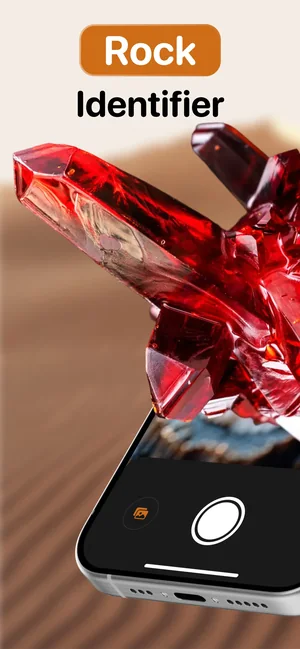
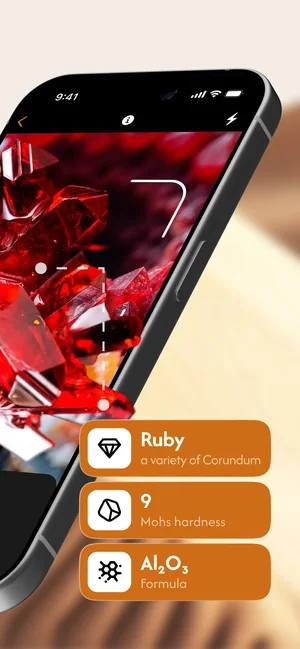
Every walk on a beach or a trail eventually produces a stone somebody wants named. Photograph it and Rock Identifier returns likely matches with the physical characteristics that separate them, backed by a knowledge base of minerals, crystals and gems.
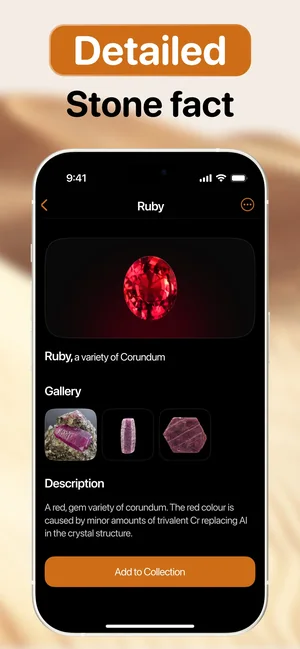
The more interesting part is what comes after the name. The app explains how to spot imitations — the question that actually matters when someone has sold you a crystal — keeps a personal collection with notes and find locations, includes a metal-detector mode that reads changes in the magnetic field, and answers follow-up questions through an AI assistant.
About this app
Rock Identifier answers the question every trail and beach eventually asks: what is this stone? Photograph it and get likely matches with key physical characteristics, backed by a clear knowledge base of minerals, crystals and gems.
The app teaches you to spot imitations, keeps a personal collection with notes and find-locations, includes a metal-detector mode that reads magnetic-field changes, and an AI assistant for follow-up questions.
Key features
- Camera identification of stones and minerals
- Guidance on spotting imitations
- Personal collection with notes
- Metal-detector mode built in
When people use it
Naming a find
A stone from a beach, a riverbed or a hillside path, photographed on the spot while you still remember where it came from.
Checking whether a crystal is what it was sold as
Glass and dyed imitations are common. The app's guidance on spotting them is aimed exactly at this.
Keeping a collection that means something
Notes and find locations turn a box of stones into a record. Where a specimen came from is often more interesting than what it is.
Learning what to look at
Hardness, lustre, streak and crystal habit are what actually distinguish minerals, and the knowledge base is built around them.
How it works
Photograph the stone
Fill the frame with one specimen in daylight. A clean, dry surface shows colour and lustre far better than a wet or dusty one.
Read the matches
You get likely candidates with their key physical characteristics rather than a single verdict.
Check against the physical tests
Compare hardness, lustre and crystal form with what you are holding. This is the step that turns a guess into an identification.
Add it to your collection
Record notes and where you found it while you still remember.
Ask follow-up questions
The AI assistant handles the questions a match list raises.
Good to know
- Identification from a photograph is a suggestion, not a determination. Many minerals are visually near-identical and are separated in practice by hardness, streak and density — tests a camera cannot perform.
- Never use this app to decide whether a stone is valuable, or whether a gem is genuine, before buying or selling. That needs a gemmologist with instruments.
- Some minerals are genuinely hazardous — asbestiform, radioactive or containing heavy metals. If a match suggests anything of that sort, stop handling it and check with a specialist rather than relying on the app.
- Metal-detector mode reads the phone's magnetometer. It responds to changes in the magnetic field nearby, which is not the same as a purpose-built detector and will not find much below the surface.
Pricing and privacy
Free · In-App Purchases. Subscriptions and purchases are handled by Apple; you can review or cancel them in your Apple Account settings.
Privacy Policy · EULA · Support and refunds
Facts on this page come from the App Store listing and the app's own screens, and were last checked on . Something out of date? Tell us.
Questions about Rock Identifier
How accurate is identifying a rock from a photo?
It is a strong suggestion on a clear photograph of a distinctive specimen, and much weaker on weathered, wet or visually ambiguous stones. Minerals are separated in practice by hardness, streak and density, none of which a photograph shows — treat the match as a starting point.
Can it tell me if my crystal is real or worth something?
It can teach you what to look for in an imitation, which is genuinely useful. It cannot value a stone or authenticate a gem — that needs a gemmologist with instruments, not a camera.
What is the metal-detector mode?
It uses the phone's magnetometer to detect changes in the magnetic field close to the device. It is a handy extra, not a replacement for a real detector, and it will not find things buried at any depth.
What is the difference between a rock and a mineral?
A mineral is a single naturally occurring substance with a definite composition and crystal structure; a rock is an aggregate of one or more minerals. Which one you are holding changes what the identifying features even are, and the knowledge base covers both.